Chopstick rests keep chopsticks from touching the table directly and stop them from rolling away. A simple job — but they have a quiet way of changing the whole mood of a meal.
→ Read: Why Use a Japanese Chopstick Rest?
The Chopstick Rest Rabbit Hole
I looked up one day and had over 50.
They’re small and affordable, but put one down and the whole mood shifts. Ridiculous value. You set your chopsticks down throughout the meal, so you’re looking at them the whole time.
A polar bear, an acorn, whatever it is — it just sits there and somehow makes everything better.
Some are even cuter as a set. Takoyaki and the spatula that flips it.
A capybara on a skateboard. Mayonnaise on a skateboard. No idea why it works, but it does.
Matching them to the food and tableware is its own game.
Soba tonight? Better get the wasabi rest out. And when guests come, picking one that suits the person is half the fun.
And here’s the thing: they look like miniature objects you’d display on a shelf — and you can — but they’re also completely practical. Sturdy, affordable, and impossible to regret buying. An airtight excuse to keep collecting.
Animal Shapes
The kind of warmth that makes a table feel a little friendlier.
The bird is small and easy to use — the reliable one of the group.
The cat looks like it’s having a great time and doesn’t care who knows it. The polar bear and capybara just sit there, unbothered, at their own pace. Somehow that’s the most soothing thing.
→ Polar Bear Chopstick Rest (Arita Ware, Japan)
→ Capybara Chopstick Rest (Arita Ware, Japan)
→ Little Bird Chopstick Rests (Hasami Ware, Japan)
→ Cat Chopstick Rest (Hasami Ware, Japan)
Food Shapes
Something about them is just off in the best way.
A chicken wing. A coffee bean. A mackerel. Mayonnaise. They’re completely sincere — but they’re absolutely coming for you.
Can’t rank them, and this category has a habit of growing on its own.
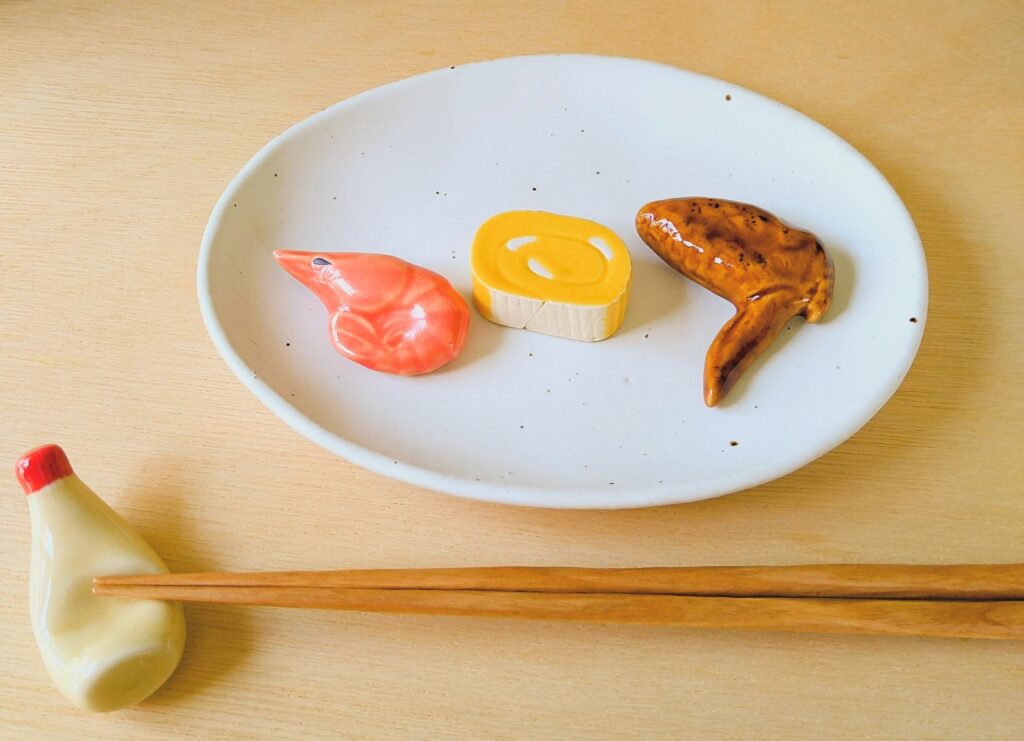
→ Chicken Wing Chopstick Rest (Mino Ware, Japan)
→ Coffee Bean–Shaped Chopstick Rests (Mino Ware, Japan)
→ Grilled Fish Chopstick Rest (Mino Ware, Japan)
→ Mayonnaise Chopstick Rest (Arita Ware, Japan)
→Taiyaki-Shaped Chopstick Rest (Mino Ware, Japan)
Simple & Minimal
Not my everyday pick — I’m drawn to the fun and chaotic ones. But for those who prefer understated elegance, these are the perfect fit. And when guests come and it feels like maybe now’s not the time to put a skateboarding capybara on the table, these are the ones that come out. 😄
→ Black Ceramic Chopstick Rest (Japan)
→ Stainless Steel Chopstick Rest (Japan)
Glass
Mostly a summer thing. I pair them with glass tableware, and they just fit — the light catches them, everything feels cooler.
Tableware air conditioning.
→ Glass Chopstick Rests (Ishizuka Glass & Aderia Tsugaru Vidro, Japan)
Nature-Inspired Shapes
Good for the in-between seasons. When spring feels far away, putting out a pale camellia helps. Acorns are for autumn.
These also travel well as gifts — animals and food shapes can be hit or miss depending on the person, but botanicals are a safe bet. Important detail.
→ Acorn Chopstick Rest (Mino Ware, Japan)
→ Camellia Chopstick Rest (Hasami Ware, Japan)
Playful Shapes
These tend to live as little display pieces, or come out when I’m doing a combination. The cuteness-multiplying effect is strong with this category.
→ Skateboard Chopstick Rest (Japan)
→ Uchiwa Chopstick Rest (Mino Ware, Japan)
How to Use Them
The basic idea is simple: rest your chopsticks on them during a meal. But the longer ones double as cutlery rests too — forks, knives, spoons all work. They show up at snack time as well. A small fork resting on a chopstick rest next to a slice of cake makes the whole thing feel a little more considered.
Match them to the food, the table, the people around it.
And on slow days — line them up, load them up, and just appreciate them.
Closing
Using them is of course a joy.
But choosing which one to use — that might be the best part.
On busy days there’s no time for any of it.
A day when you can pause and pick a chopstick rest is a peaceful, unhurried day.
And then you notice: one is never enough.
Before you know it, you have more.
That’s the rabbit hole. That’s exactly what it is.
Leave a Reply