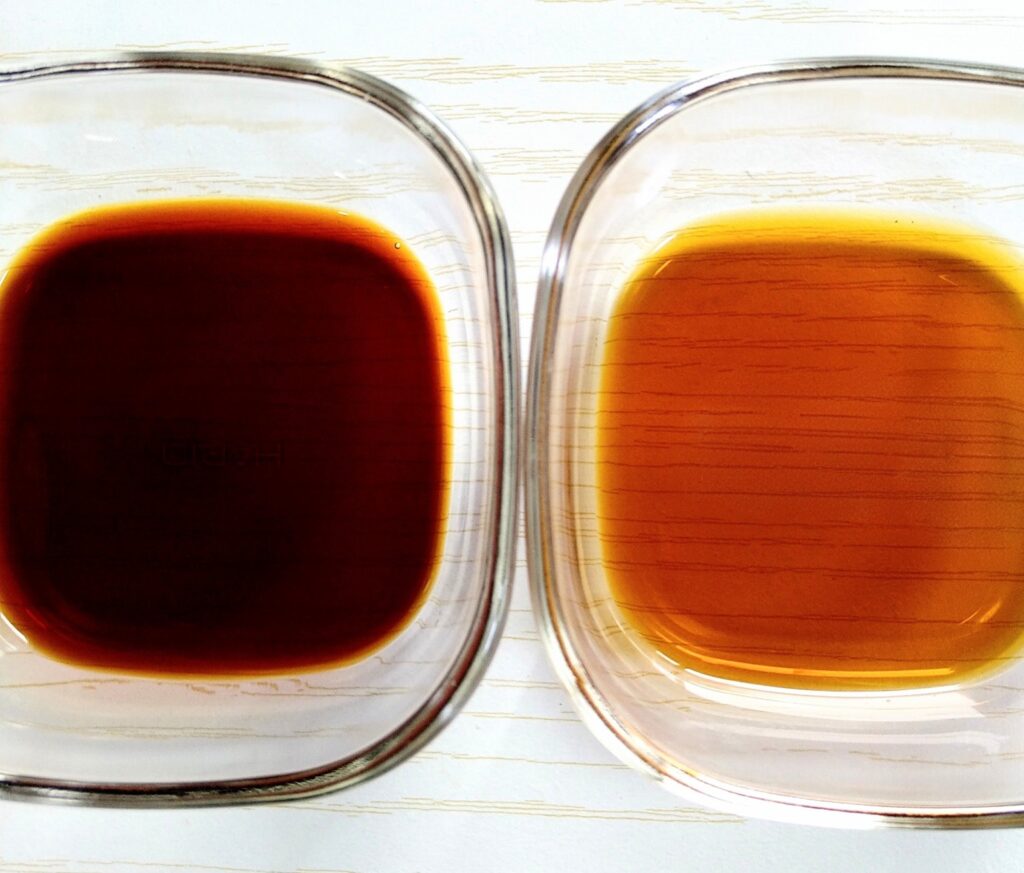
Dark soy sauce (left) and light soy sauce (right).
What is Shoyu?
Shoyu (醤油) is the Japanese word for soy sauce — a fermented seasoning made from soybeans, wheat, salt, and water.
It is one of the most fundamental ingredients in Japanese cooking, used in almost everything from dipping sauces and simmered dishes to everyday seasoning.
The two most common types are koikuchi (dark soy sauce) and usukuchi (light soy sauce). Unlike salt, shoyu adds not just saltiness but also umami, color, and aroma to a dish.
A Brief History
Soy sauce has a long history in Japan.
It is generally believed that its roots trace back to the Nara period (710–794), when a grain-based seasoning called kokubishio was introduced from China. During the Kamakura period (1185–1333), Zen monks began using tamari — a liquid byproduct of miso — as a seasoning. This became a direct ancestor of modern shoyu.
The word shoyu first appeared in Japanese records around the 1500s, during the Muromachi period. By the Edo period (1603–1867), soy sauce production flourished across Japan, and it became an essential part of everyday cooking.
Why Two Styles?
Japan’s two main soy sauce styles — koikuchi in the east and usukuchi in the west — reflect the different food cultures and geography of their regions.
In the Kanto region, koikuchi developed to suit the bold flavors of Edo cuisine. The city of Edo grew rapidly and consumed enormous quantities of seafood — not always at its freshest. Koikuchi’s strong aroma and deep flavor helped mask unwanted smells and complemented the rich, robust dishes of the era.
In Kyoto, the situation was different. As an inland city, fresh seafood was hard to come by. Cooking centered around vegetables, tofu, and preserved fish — ingredients with no strong smell to mask. A lighter soy sauce that enhanced the natural color and flavor of these ingredients made more sense. Usukuchi developed in Tatsuno, Hyogo prefecture — a town with access to quality salt from nearby Ako, good soybeans and wheat, and soft water from the Ibo River. These natural conditions made it the ideal place for a lighter, more delicate soy sauce to develop.
The Two Main Types
Koikuchi (dark soy sauce)
Koikuchi is the most common type of Japanese soy sauce, accounting for about 80% of domestic production.
It is made from roughly equal parts soybeans and wheat, and undergoes a longer fermentation process — typically two years or more. This results in a deep brown color, a rich aroma, and a full-bodied flavor with well-balanced umami.
Usukuchi (light soy sauce)
Usukuchi accounts for about 14% of Japanese soy sauce production and is particularly popular in the Kansai region.
It is brewed for a shorter period — around one year — and uses more salt to control fermentation. Some include rice, which adds a natural sweetness to balance the flavor despite the shorter aging time. The result is a lighter color, a milder aroma, and a slightly saltier taste than koikuchi.
Key Differences
| Koikuchi | Usukuchi | |
|---|---|---|
| Color | Dark brown | Light amber |
| Salt content | ~16-17% | ~18-19% |
| Fermentation | 2+ years | ~1 year |
| Main ingredients | Soybeans, wheat, salt, water | Soybeans, wheat, salt, water (some include rice) |
| Flavor | Rich, full-bodied, strong umami | Lighter, milder, slightly saltier |
| Best for | Rich, bold dishes | Light, delicate dishes |
How I Use Them
I use koikuchi for richer dishes — simmered dishes, ingredients with higher fat content, or food that isn’t at its freshest. It also works well when I want more depth and richness in a dish. It pairs well with sugar and mirin, and holds up to bold seasoning.
Usukuchi is my go-to for fresh ingredients — sashimi, lightly cooked vegetables, and light dashi-based dishes. I use it when I want the natural flavor of the ingredients to come through.
I actually use usukuchi more often than koikuchi in my everyday cooking. I tend to prefer lighter seasoning, and usukuchi fits that naturally.
The Soy Sauces I Use
These are the two soy sauces I use at home.
Both ship from Japan, so they may not be the most convenient option for everyone — but if you’re looking to try quality Japanese soy sauce, these are a good place to start.
Koikuchi → Adachi Jozo Organic Koikuchi on Amazon Japan
Usukuchi → Higashimaru Usukuchi on Amazon Japan
Note that the usukuchi is only available in a set of three or four bottles on Amazon Japan.
For a closer look at the usukuchi I use, you can read more here.
→ A Japanese Light Soy Sauce (Usukuchi) I Use Every Day
Closing
Koikuchi and usukuchi are both shoyu — but they bring different things to the table. Knowing the difference makes it easier to choose the right one for the dish you’re cooking.
Leave a Reply