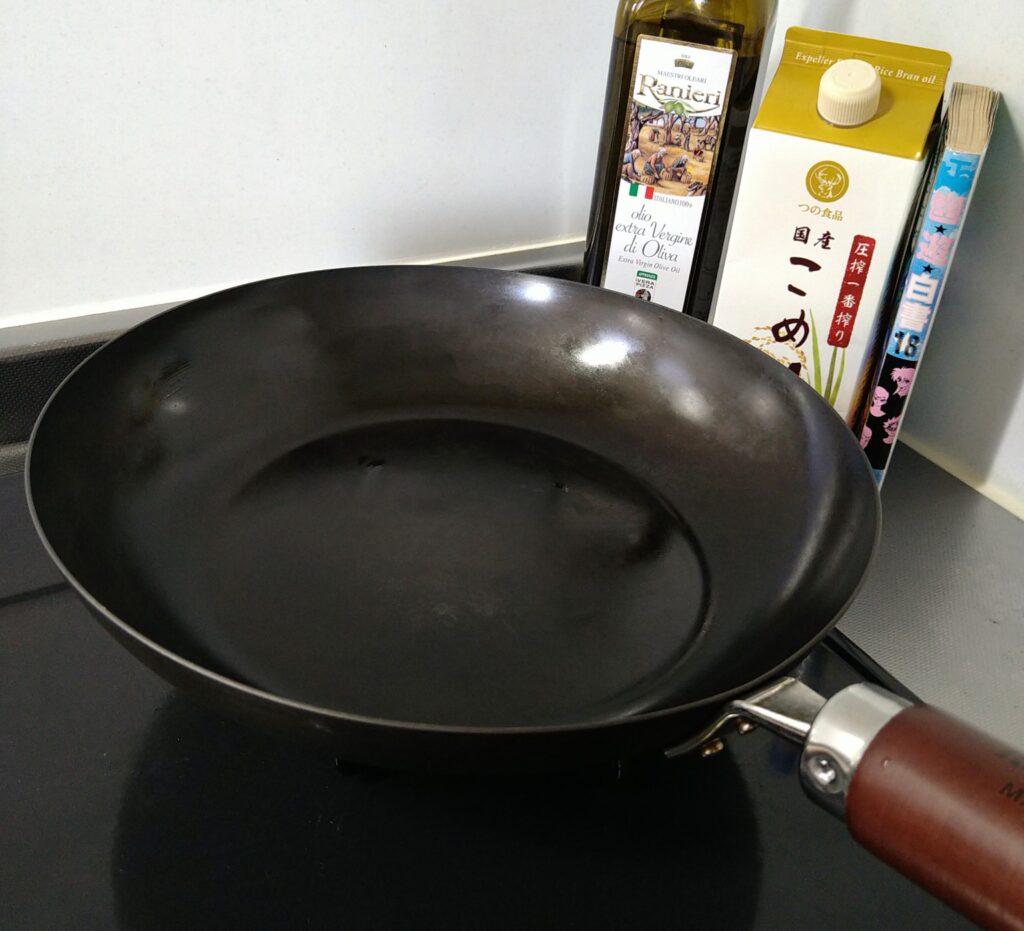
The first manga I ever bought was Yu Yu Hakusho — a 90s manga about a teenage delinquent turned spirit detective, fighting increasingly powerful demons.
Bear with me. I will explain cast iron cooking through Yu Yu Hakusho theory. If you get it, you get it. If you don’t — you might still learn something about cast iron.
I’d gotten pretty comfortable with cast iron. Eggs, meat, fish — nothing was sticking. I thought I had it figured out. Then I tried cooking carbs, and hit a wall. That’s when I realized: there’s a power hierarchy. And not all carbs are equal.
The Enemy Rankings
Cooking on cast iron requires a barrier — a protective layer between the food and the pan. In Yu Yu Hakusho, this is called a kekkai.
You also need to know what you’re up against.
E-Rank — High-moisture vegetables / Carbs (pancakes)
A weak kekkai is enough. Small fry.
I debated D or C for pancakes. They behave like protein at first — sticking, then releasing as heat gets through. But they let go even with a weak kekkai. E rank stands. Disagreement noted.
D-Rank — High-starch vegetables
A basic kekkai handles it. Still small fry.
C-Rank — Protein (meat, eggs)
The kekkai takes care of them. They may stick at first, but once heat gets in, they naturally release. If they don’t, add a small splash of water or take the pan off the heat and wait.
B-Rank — Protein (fish) / Carbs (fried rice)
The kekkai mostly works, but fish skin can stick in spots.
Fried rice held at B, but only with proper moisture control.
Don’t get complacent.
A-Rank — Carbs (gyoza)
These break through the kekkai. They don’t release with time — they dig in deeper. Gyoza with soft, high-moisture wrappers are borderline S rank. The kekkai alone won’t save you. You need a Spirit Detective.
S-Rank — Carbs (???)
There’s always a higher rank. It’s out there, somewhere in the carb category. I just haven’t met it yet.
How Proteins and Carbs Behave Differently
Protein firms up as moisture evaporates, then releases. Wait long enough and it usually lets go on its own.
Carbs are different — or so I thought. After my early struggles with gyoza, I assumed all carbs were formidable enemies. But then fried rice came in at B-Rank, and pancakes at E-Rank. It turns out the real threat is more specific. Gyoza are the outlier. As they cook, the starch gelatinizes — absorbing moisture and forming a thin, glue-like layer that bonds to the pan surface. Waiting makes it worse.
How to Maintain the Kekkai — and Fight A-Rank Enemies
The foundation of cast iron cooking is the kekkai — keeping food from bonding directly to the metal. Preheating and oil are what create it. Against A-Rank enemies, you also need moisture management to maintain the kekkai, and the right tool to cut through what breaks past it — the Spirit Detective.
Preheat + Oil — The Kekkai
A properly heated pan sears the surface of food the moment it makes contact. Oil gets between the food and the metal, preventing direct contact. Together, these two create the kekkai. Without enough preheat, the surface bonds before it can sear. Too little oil, and the metal is exposed.
That said, the kekkai can be too strong.
Push it too far and it damages the one casting it — in Yu Yu Hakusho terms, that’s Master Genkai herself. In my case, heating until smoke appears means olive oil fumes hit my throat. Pull back just before the smoke — when you see the faintest wisp, lower the heat. That’s the sweet spot.
Moisture Management — Maintaining the Kekkai
Excess moisture drops the pan temperature and weakens the kekkai. Keep the surface of your ingredients as dry as possible.
Fried rice staying at B-Rank depends entirely on this.
The Right Tool — The Spirit Detective
If the kekkai and moisture management still aren’t enough, you need the right tool to cut through what gets past them.
Closing
For a more specific breakdown of how to fight A-Rank enemies — using gyoza as the example — I’ve written a separate article.
Fair warning: it drops the Yu Yu Hakusho framing entirely and reads like a normal cooking post.
→ How to Cook Gyoza in a Cast Iron Pan — Why It Sticks and What to Do About It
Now, I thought I’d pulled off a near-perfect fusion of cast iron cooking and Yu Yu Hakusho — but once I finished writing, I noticed a fatal flaw. In the actual series, B and C-Rank demons can slip through barrier gaps, and anything D-Rank or below passes right through.
I thought about flipping it — putting vegetables at S-rank, protein at A-rank. But that felt completely wrong.
In the end, I couldn’t find a clean solution.
The Yu Yu Hakusho theory of cast iron cooking remains unfinished. I’m sorry to anyone who read this far expecting a satisfying conclusion. But I intend to keep thinking about it.
Note: the stronger the demon energy, the more effective the kekkai.
Leave a Reply